
 Facebook
 X
X LinkedIn
 Forward
(Day 1 Friday) MASAM SUD PEARLS FOR PRACTICE: Equity and Innovation in Addiction Care 2025
CREDIT ONLY COURSE
Jointly Provided by:
Massachusetts Society of Addiction Medicine (MASAM) & Baystate Continuing Interprofessional Education
Goal:
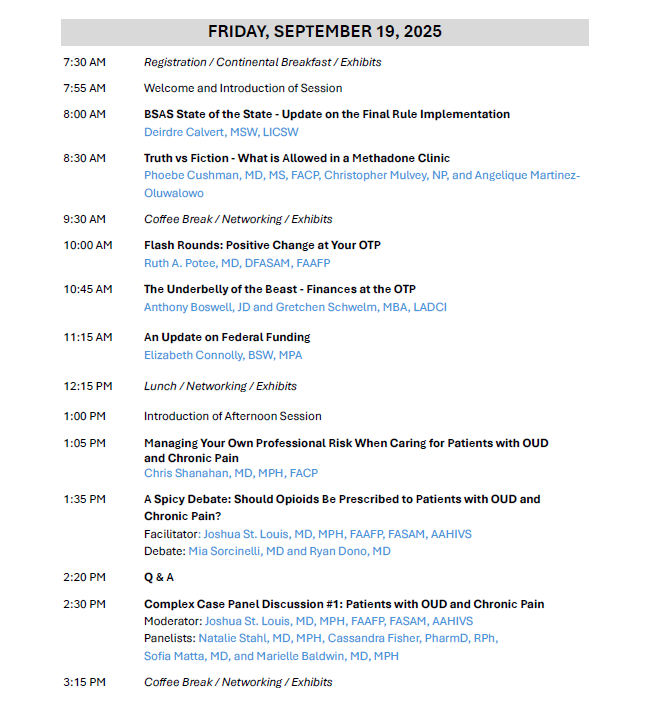
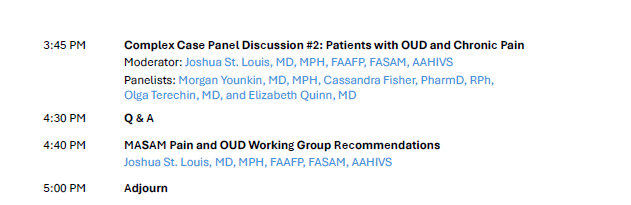
This program will prepare attendees to develop the knowledge, skills, and attitudes required to identify and manage substance use disorders and addiction comorbidities in their practices. Methadone will be covered on Friday, starting with an update from BSAS, dosing, and inductions at OTPs. hospital inductions, and safety. Saturday will include updates on psychedelics, harm reduction, treatment access, incorporating families within treatment, ADA and SUD, Alcohol, Buprenorphine, and legislative updates.
Target Audience
This course is designed for: Physicians, Physician Assistants, Pharmacists, Nurse Practitioners, OTPs and other prescribers, Social Workers.
Learning Objectives
As a result of attending this educational activity, attendees should be able to:
1|Review the current state of substance use disorder treatment in Massachusetts.
2|Explain recent advancements in methadone treatment access, including state regulatory waivers and guidance updates for initial screenings by RNs/LPNs, telehealth for full methadone examinations, and changes to take-home dose locked container requirements.
3|Discuss future strategies for improving substance use disorder treatment, including the development of the MA OTP Training and Technical Assistance Center.
4|Distinguish between common myths and evidence-based facts regarding permissible activities, treatments, and patient protocols in a methadone clinic, including regulations on take-home doses and drug screening.
5|Evaluate the scope of allowable clinical services in a methadone clinic, such as counseling, medical assessments, and integration with external care, to clarify misconceptions and promote effective treatment for opioid use disorder.
6|Summarize rapid induction pathways utilized by some Massachusetts OTPs
7|Identify at least three SAMHSA 2024 regulatory changes that are being implemented in Massachusetts OTPs
8|List one lowered barrier to access to methadone treatment in the last year
9|Identify Sources of Predictable operational costs in the opioid treatment program setting.
10|Identify eight sources of unpredictable operational costs in the opioid treatment program setting.
11|Explain four components for sustainable strategic planning in the opioid treatment program setting.
12|Identify changes in Federal Funding policies
13|Discuss funding challenges
14|Identify Available Funding Opportunities
15|Identify common documentation deficiencies that place clinicians at risk of BORIM or DEA scrutiny.
16|Apply evidence-based strategies to improve clinical documentation and risk–benefit decision-making in the care of patients with OUD and chronic pain.
17|Demonstrate how to document treatment decisions and monitoring activities in a way that conveys a consistent focus on patient safety and mitigating risk.
18|Review in depth the pros and cons of providing full agonist Opioids to patients with a history of OUD
19|Formulate a framework to review complex cases
20|Discuss complex cases of SUD and chronic pain with a focus on nuanced decision making
21|Formulate a framework to review complex cases for clinicians
22|Discuss the overview of the structure and format of the MASAM 2025 Pain Task Force
23|Review the final recommendations of the pain task force
24|Discuss recommendations from MASAM members and consider next steps
FACULTY
Individual | Individual's Role in Activity | Financial Relationship Disclosure | Discussion of | ||
|---|---|---|---|---|---|
Jessica Gray, MD | Planning Committee Member & Speaker | No relevant relationships with ineligible companies to disclose | No | ||
| Maria Quinn, MSN, PMHNP-BC | Planning Committee Member & Speaker | No relevant relationships with ineligible companies to disclose | No | ||
| Ruth Potee, MD, DFASAM, FAAFP | Planning Committee Member & Speaker | No relevant relationships with ineligible companies to disclose | No | ||
| Joshua St. Louis, MD, MPH | Planning Committee Member & Speaker | No relevant relationships with ineligible companies to disclose | No | ||
| Sarah Bagley, MD, MSc | Speaker | No relevant relationships with ineligible companies to disclose | No | ||
| Marielle Baldwin, MD, MPH | Speaker | No relevant relationships with ineligible companies to disclose | No | ||
| Anthony Boswell, JD | Speaker | No relevant relationships with ineligible companies to disclose | No | ||
| Deidre Calvert, MSW, LICSW | Speaker | No relevant relationships with ineligible companies to disclose | No | ||
| Elizabeth Connolly, BSW, MPA | Speaker | No relevant relationships with ineligible companies to disclose | No | ||
| Phoebe Cushman, MD, MS | Panelist | No relevant relationships with ineligible companies to disclose | No | ||
| Ryan Dono, MD | Panelist |
| No | ||
| Sofia Matta, MD | Panelist |
| No | ||
| Christopher Mulvey, NP | Panelist | No relevant relationships with ineligible companies to disclose | No | ||
| Angelique Martinez Oluwalowo | Panelist | No relevant relationships with ineligible companies to disclose | No | ||
| Elizabeth Quinn, MD | Panelist | No relevant relationship with ineligible companies to disclose | No | ||
| Chris Shanahan, MD, MPH | Speaker | No relevant relationships with ineligible companies to disclose | No | ||
| Mia Sorcinelli,MD | Panelist | No relevant relationships with ineligible companies to disclose | No | ||
| Natalie Stahl, MD, MPH | Panelist | No relevant relationship with ineligible companies to disclose | No | ||
| Gretchen Schwelm, MBA, LADCI | Panelist | No relevant relationship with ineligible companies to disclose | No | ||
| Olga Terechin, MD | Panelist | No relevant relationship with ineligible companies to disclose | No | ||
| Cassandra Fisher, PhamrD RPh | Panelist | No relevant relationship with ineligible companies to disclose | No | ||
| Morgan Younkin, MD, MPH | Panelist | No relevant relationship with ineligible companies to disclosure | No |
POLICY ON FACULTY AND SPONSOR DISCLOSURE
The design and content of Baystate Continuing Interprofessional Education (CE) activities support quality improvement in healthcare and provide fair and balanced views of therapeutic options. Any relevant financial relationships are mitigated prior to the educational activity.
None of the planners for this educational activity have relevant financial relationship(s) to disclose with ineligible companies whose primary business is producing, marketing, selling, re-selling, or distributing healthcare products used by or on patients.
 In support of improving patient care, Baystate Health is jointly accredited by the Accreditation Council for Continuing Medical Education (ACCME), the Accreditation Council for Pharmacy Education (ACPE), and American Nurses Credentialing Center (ANCC), to provide continuing education for the healthcare team.
Physicians
Baystate Continuing Interprofessional Education designates this live activity for a maximum of 7.00 AMA PRA Category 1 Credit(s)TM. Physicians should only claim the credit commensurate with the extent of their participation in the activity.
Nurses
Baystate Continuing Interprofessional Education designates this live activity for a maximum of 7.00 contact hour(s). Nurses should only claim the credit commensurate with the extent of their participation in the activity.
 This activity was planned by and for the healthcare team and learners will receive 7.00 Interprofessional Continuing Education (IPCE) credit for learning and change.
Available Credit
- 7.00 AMA PRA Category 1 Credit™
- 7.00 ANCC Contact Hours
- 7.00 IPCE Credit Hour(s)