
 Facebook
 X
X LinkedIn
 Forward
(Day 2 Saturday) MASAM SUD PEARLS FOR PRACTICE: Equity and Innovation in Addiction Care 2025
CREDIT ONLY COURSE
Jointly Provided by:
Massachusetts Society of Addiction Medicine (MASAM) & Baystate Continuing Interprofessional Education
Goal:
This program will prepare attendees to develop the knowledge, skills, and attitudes required to identify and manage substance use disorders and addiction comorbidities in their practices. Methadone will be covered on Friday, starting with an update from BSAS, dosing, and inductions at OTPs. hospital inductions, and safety. Saturday will include updates on psychedelics, harm reduction, treatment access, incorporating families within treatment, ADA and SUD, Alcohol, Buprenorphine, and legislative updates.
Target Audience
This course is designed for: Physicians, Physician Assistants, Pharmacists, Nurse Practitioners, OTPs and other prescribers, Social Workers.
Learning Objectives
As a result of attending this educational activity, attendees should be able to:
1|Describe evidence-based strategies for building recovery capital that prioritize equity, such as culturally responsive interventions and policy advocacy.
2|Develop one actionable plan to enhance recovery capital.
3|Describe the Structure and Function of ACS Programs
4|Identify Strategies for Improving Access to Addiction Treatment:
5|Apply Knowledge of Multidisciplinary Collaboration
6|Recognize Emerging Challenges in Substance Use Treatment
7|Describe the pharmacology of GLP-1 receptor agonists
8|Evaluate the emerging evidence base to support their use in treating substance use disorders
9|Outline the research underway to study their use to treat substance use disorders
10|Demonstrate practical, developmentally informed techniques into clinical encounters to support early intervention and reduce risk in youth.
11|Recognize the role of confidentiality, family involvement, and consent laws in adolescent substance use care.
12|Describe key features of Gambling Disorder in behavioral health care
13|Distinguish between Problem, and disordered gambling
14|Identify Screening and Assessment to tools used in clinical practice
15|Apply culturally responsive, evidence-based interventions
16|Define harm reduction by exploring its core principles, misconceptions, historical context, and statistical impact.
17|Examine key harm reduction frameworks, including the Four Pillars Drug Strategy and the Six Pillars of Harm Reduction, and their relevance to public health and treatment.
18|Identify Barriers to care for individuals with substance use disorder and explore harm reduction interventions that break the barriers, using the stages of change
19|Describe key controversies surrounding benzodiazepine use
20|Identify clinical signs and symptoms of benzodiazepine withdrawal and differentiate them from other substance withdrawal syndromes.
21|Summarize the current evidence base for benzodiazepine tapering protocols
22|Apply evidence-based management strategies for benzodiazepine use disorder
23|Evaluate emerging research on alternatives to benzodiazepine
24|Identify key disparities in access to recovery capital across diverse populations.
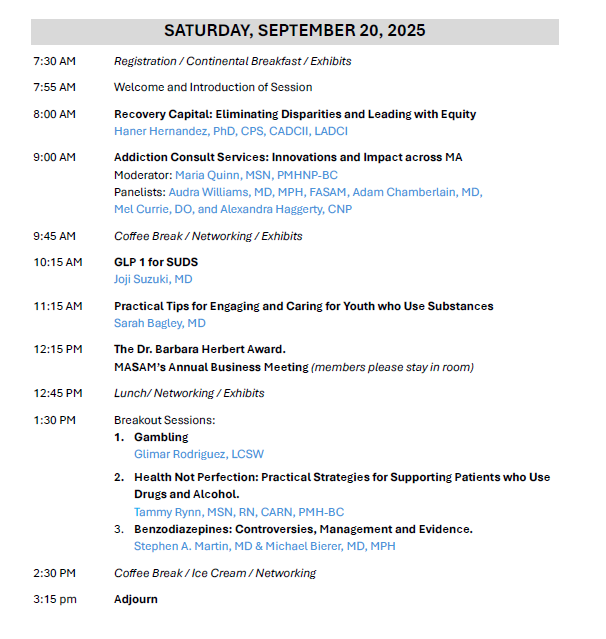
FACULTY
Individual | Individual's Role in Activity | Financial Relationship Disclosure | Discussion of |
|---|---|---|---|
Jessica Gray, MD | Planning Committee Member& Speaker | No relevant relationships with ineligible companies to disclose | No |
| Maria Quinn, MSN, PMHNP-BC | Planning Committee Member & Speaker | No relevant relationships with ineligible companies to disclose | No |
| Ruth Potee, MD, DFASAM, FAAFP | Planning Committee Member & Speaker | No relevant relationships with ineligible companies to disclose | No |
| Joshua St. Louis, MD, MPH | Planning Committee Member & Speaker | No relevant relationships with ineligible companies to disclose | No |
| Sarah Bagley, MD, MSc | Speaker | No relevant relationships with ineligible companies to disclose | No |
| Michael Bierer, MD, MPH | Speaker | No relevant relationships with ineligible companies to disclose | No |
| Adam Chamberlain, MD | Panelist | No relevant relationships with ineligible companies to disclose | No |
| Mel Currie, DO | Panelist | No relevant relationships with ineligible companies to disclose | No |
| Haner Hernandez, PhD, CPS | Speaker | No relevant relationships with ineligible companies to disclose | No |
| Alexandra Haggerty, CNP | Planner | No relevant relationship with ineligible companies to disclose | No |
| Stephen A. Martin, MD | Speaker | No relevant relationships with ineligible companies to disclose | No |
| Elizabeth Quinn, MD | Panelist | No relevant relationship with ineligible companies to disclose | No |
| Glimar Rodriguez, LADCI, LICSW | Speaker | No relevant relationship with ineligible companies to disclose | No |
| Tammy Rynn, MSN, RN | Speaker | No relevant relationship with ineligible companies to disclose | No |
| Joji Suzuki, MD | Speaker | Receives In-kind research support from Braeburn, NIH funding to conduct clinical trials including for semaglutide for OUD (R21DA060304). | Use of GLP-1 agonists and related medications to treat substance use disorders. |
| Audra Williams, MD, MPH | Panelist | No relevant relationship with ineligible companies to disclose | No |
POLICY ON FACULTY AND SPONSOR DISCLOSURE
The design and content of Baystate Continuing Interprofessional Education (CE) activities support quality improvement in healthcare and provide fair and balanced views of therapeutic options. Any relevant financial relationships are mitigated prior to the educational activity.
Dr. Joji Suzuki Receives In-kind research support from Braeburn and NIH funding to conduct clinical trials including for semaglutide for OUD (R21DA060304).
All of the relevant financial relationships listed for these individuals have been mitigated.
None of the other planners or faculty for this educational activity have relevant financial relationship(s) to disclose with ineligible companies whose primary business is producing, marketing, selling, re-selling, or distributing healthcare products used by or on patients.
 In support of improving patient care, Baystate Health is jointly accredited by the Accreditation Council for Continuing Medical Education (ACCME), the Accreditation Council for Pharmacy Education (ACPE), and American Nurses Credentialing Center (ANCC), to provide continuing education for the healthcare team.
Physicians
Baystate Continuing Interprofessional Education designates this live activity for a maximum of 4.75 AMA PRA Category 1 Credit(s)TM. Physicians should only claim the credit commensurate with the extent of their participation in the activity.
Nurses
Baystate Continuing Interprofessional Education designates this live activity for a maximum of 4.75 contact hour(s). Nurses should only claim the credit commensurate with the extent of their participation in the activity.
 This activity was planned by and for the healthcare team and learners will receive 4.75 Interprofessional Continuing Education (IPCE) credit for learning and change.
Available Credit
- 4.75 AMA PRA Category 1 Credit™
- 4.75 ANCC Contact Hours
- 4.75 IPCE Credit Hour(s)