
 Facebook
 X
X LinkedIn
 Forward
MASAM SUD Pearls for Practice: Raising the Standard in Addiction Care
CREDIT ONLY COURSE
Jointly Provided by:
Massachusetts Society of Addiction Medicine (MASAM) & Baystate Continuing Interprofessional Education
Goal:
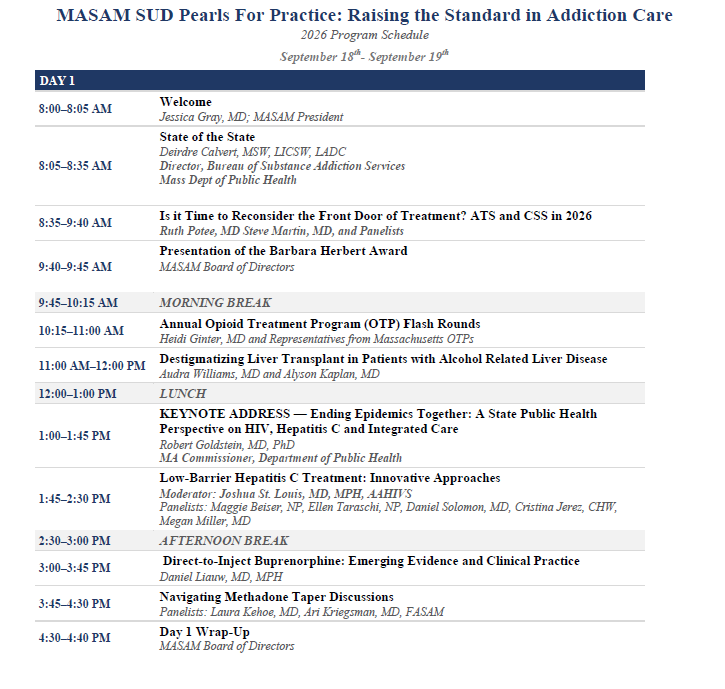
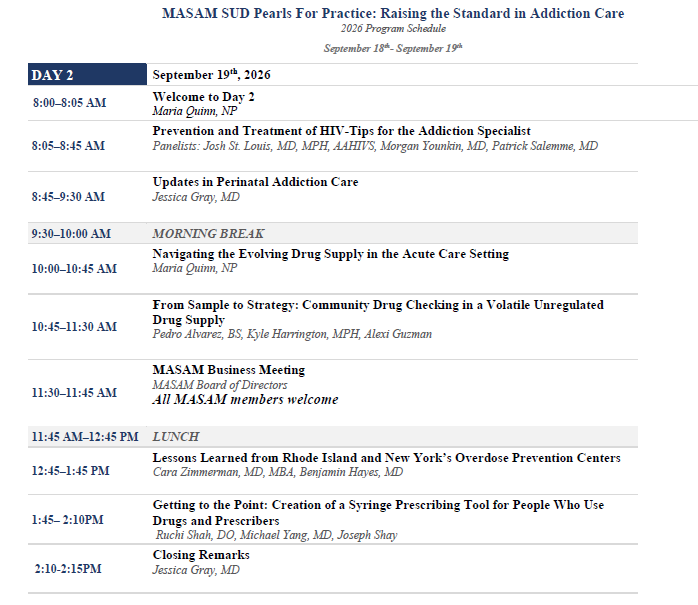
This program will prepare attendees to develop the knowledge, skills, and attitudes required to identify and manage substance use disorders and addiction comorbidities in their practices.This program will prepare attendees to develop the knowledge, skills, and attitudes required to identify and manage substance use disorders and addiction comorbidities in their practices. Friday will begin with a focus on Acute treatment services (ATS) level of addiction care in our state, including an update from BSAS, review of history, and panel on innovations and overcoming common challenges in providing evidence-based treatment. Friday will also include updates on methadone innovations in our state, alcohol use and hepatology, update on SUD and HCV trends in our state by DPH, and innovations in medication for opioid use disorder. Saturday will include updates on stimulant use treatment, perinatal addiction care, low barrier HIV prevention and treatment and, harm reduction innovations in our state.
Target Audience
This course is designed for: Physicians, Physician Assistants, Pharmacists, Nurse Practitioners, OTPs and other prescribers, Social Workers.
Learning Objectives
As a result of attending this educational activity, attendees should be able to:
- Identify changes and trends in the illicit drug supply (e.g., fentanyl, stimulants and contaminants) and develop individualized, evidence-based treatment protocols for patients in opioid treatment programs and other care settings.
- Analyze and apply federal and state regulations to reduce barriers to SUD treatment and improve retention rates.
- Describe infectious complications of substance use disorders and ways to improve treatment and prevention
- Assess and refine in-patient and outpatient addiction treatment protocols to ensure they are trauma-informed, patient-centered, and aligned with harm reduction principles.
- Apply effective communication strategies with interdisciplinary teams and partners during care transitions to ensure ADA-compliant, equitable access to SUD treatment across all levels of care.
Course summary
- 10.25 AAPA Category 1 CME creditBaystate Health has been authorized by the American Academy of PAs (AAPA) to award AAPA Category 1 CME credit for activities planned in accordance with AAPA CME Criteria. This activity is designated for 10.25 AAPA Category 1 CME credits. PA’s should only claim credit commensurate with the extent of their participation.
- 10.25 AMA PRA Category 1 Credit™
- 10.25 ANCC Contact Hours
- 10.25 IPCE Credit Hour(s)
POLICY ON FACULTY AND SPONSOR DISCLOSURE
The design and content of Baystate Continuing Interprofessional Education (CE) activities support quality improvement in healthcare and provide fair and balanced views of therapeutic options. Any relevant financial relationships are mitigated prior to the educational activity.
None of the planners for this educational activity have relevant financial relationship(s) to disclose with ineligible companies whose primary business is producing, marketing, selling, re-selling, or distributing healthcare products used by or on patients.
 In support of improving patient care, Baystate Health is jointly accredited by the Accreditation Council for Continuing Medical Education (ACCME), the Accreditation Council for Pharmacy Education (ACPE), and American Nurses Credentialing Center (ANCC), to provide continuing education for the healthcare team.
Physicians
Baystate Continuing Interprofessional Education designates this live activity for a maximum of 10.25 AMA PRA Category 1 Credit(s)TM. Physicians should only claim the credit commensurate with the extent of their participation in the activity.
Nurses
Baystate Continuing Interprofessional Education designates this live activity for a maximum of 10.25 contact hour(s). Nurses should only claim the credit commensurate with the extent of their participation in the activity.
AAPA Credit Designation Statement
AAPA accepts AMA category 1 credit for the PRA from organizations accredited by ACCME. Baystate Health has been authorized by the American Academy of PAs (AAPA) to award AAPA Category 1 CME credit for activities planned in accordance with AAPA CME Criteria. This activity is designated for 10.25 AAPA Category 1 CME credit(s). PA’s should only claim credit commensurate with the extent of their participation.
 This activity was planned by and for the healthcare team and learners will receive 10.25 Interprofessional Continuing Education (IPCE) credit for learning and change.
Available Credit
- 10.25 AAPA Category 1 CME creditBaystate Health has been authorized by the American Academy of PAs (AAPA) to award AAPA Category 1 CME credit for activities planned in accordance with AAPA CME Criteria. This activity is designated for 10.25 AAPA Category 1 CME credits. PA’s should only claim credit commensurate with the extent of their participation.
- 10.25 AMA PRA Category 1 Credit™
- 10.25 ANCC Contact Hours
- 10.25 IPCE Credit Hour(s)
Reminder: Complete Your Evaluation and Claim Credit for the MASAM SUD Pearls for Practice: Raising the Standard in Addiction Care
You have 7 days following the conference to complete the evaluation and claim your continuing education credit in EthosCE.
After the 7-day deadline, the evaluation will close and credit will no longer be available. Please complete all required steps before the deadline to ensure your credit is recorded.